Key Stats
Data as of April 2026This guide explains the rules, the local school requirements, and the practical risks Temecula families are actually navigating in 2026. It is not legal advice, but it will help you ask better questions before buying or riding — and it reflects what actually changed when AB 875 and AB 544 took effect on January 1.
California law still classifies e-bikes as bicycles. Enforcement, insurance, and civil liability increasingly treat them like motor vehicles. Every section below sits somewhere along that line.
Refresh this page before each school year — Temecula e-bike law has changed four years running, and the 2026 shifts are unlikely to be the last.
The Three E-Bike Classes, in Plain English
Most Temecula families get this wrong: they assume all e-bikes follow the same rules. They don't. The class determines age limits, helmet requirements, and where the bike is legal to ride — and the difference between Class 2 and Class 3 is the difference between "any age with a helmet" and "16 or older, period."
The 20-mph class limit is a motor cutoff, not a speed cap. On a Temecula downhill, gravity doesn't check your class.
California recognizes exactly three legal classes of electric bicycle. If a vehicle doesn't fit one of these three, it is not an e-bike — it's a motor vehicle that requires licensing, registration, and insurance, and the sheriff's department has been impounding them across Southern California for the last two years.
Class 1 is pedal-assist only. The motor helps when you pedal and cuts off at 20 mph. These are the e-bikes most cycling commuters use.
Class 2 has a throttle. You can propel the bike without pedaling at all. Motor cuts off at 20 mph.
Class 3 is pedal-assist — no throttle — but the motor keeps helping up to 28 mph. Class 3 is the one Temecula parents need to pay attention to, because the higher speed comes with age and safety requirements that don't apply to Class 1 or 2.
| Class | Propulsion | Max Speed | Min Age | Helmet | Sidewalk? | City Parks? |
|---|---|---|---|---|---|---|
| Class 1 | Pedal-assist only | 20 mph | None | Required under 18 | Most sidewalks, not business districts or near schools | Class 1 trails only, adjacent to parks |
| Class 2 | Throttle (no pedaling required) | 20 mph | None | Required under 18 | Most sidewalks, not business districts or near schools | Prohibited |
| Class 3 | Pedal-assist only | 28 mph | 16+ | Required all ages | Never — prohibited on all sidewalks | Prohibited |
California Vehicle Code §312.5, §21212, §21213; Temecula Municipal Code §10.24.040, §12.04.050 (Ord. 2024-02). As of April 2026.
If the vehicle has no pedals at all, or the motor is over 750 watts, it is not any class of e-bike. The Sur-ron, Talaria, and Segway X260 all fall into that category. They are legally electric motorcycles. Riding one on a public road without a license, registration, and insurance will get it impounded, and the Riverside County Sheriff's Department has been doing exactly that.
What Changed in January 2026
Two new California laws took effect on January 1, 2026, and a third clarification sharpened existing parental liability. Most Temecula parents haven't caught up yet.
AB 875 — on-the-spot impoundment. Before 2026, a minor riding a Class 3 e-bike could be cited and released, and the bike went home with them. That changed. AB 875 authorizes law enforcement to impound the bike at the scene. Your 13-year-old's $3,000 Class 3 e-bike comes home from the impound lot, not from the traffic stop.
AB 544 — mandatory red light or reflector. Every e-bike now has to be equipped with a red reflector or a solid or flashing red light at all hours of operation. Not just after dark — "all hours." If the factory equipment has been removed or damaged, the rider can be cited for it.
Clarified civil liability. California Civil Code §1714.1 has always held parents jointly and severally liable for a minor's willful misconduct, but the 2025 adjustment capped that exposure at $56,400 per tort. The 2026 vehicle code clarifications made clear that this applies specifically when a minor's e-bike ride causes injury or property damage. For Temecula parents, this is not theoretical — it is a number that appears in civil demand letters after a crash.
Where You Can Actually Ride in Temecula
This is the section most parents actually need, and the one Temecula's own ordinance language buries.
Sidewalks. Class 1 and Class 2 e-bikes may be ridden on most Temecula sidewalks, but the rider must travel in the direction of traffic, yield to pedestrians, and give an audible signal when passing. Class 3 e-bikes are prohibited on all sidewalks — no exceptions, no signage required. This is under Temecula Municipal Code §10.24.040, amended by Ordinance 2024-02 in July 2024.
Business districts — Old Town in particular. Any sidewalk where bicycle riding is prohibited by ordinance and signed accordingly is off-limits to Class 1 and Class 2 e-bikes as well. Old Town Temecula is the most-enforced example. Walk your bike on the Main Street sidewalks between Front and 6th — don't ride.
Near schools. Sidewalks adjacent to schools are designated no-ride zones for e-bikes. Parents dropping kids off who expect to see a Class 1 e-bike legally on the school-adjacent sidewalk should know that isn't how the ordinance is written.
Bridges and underpasses. Same rule — prohibited. These are specifically called out in the municipal code.
City parks. Under Temecula Municipal Code §12.04.050, only Class 1 e-bikes are permitted inside city parks, and only on Class 1 bike trails adjacent to or within the park. Class 2 and Class 3 are prohibited in parks entirely. If a Class 2 can get you into the park under motor, that's a citation.
Bike lanes. E-bikes of all three classes are welcome in bike lanes. The direction of travel rule is the same as for cars — you ride with traffic, not against it. This is the single most common thing riders get wrong.
At night. Under AB 544, every e-bike must have a functioning red reflector or red light during all hours of operation. If you're riding after sunset without one in 2026, you are cited.
What TVUSD Requires for Students Who Ride to School
The Temecula Valley Unified School District launched its Safe Riders Program in August 2025. It is not optional if your student wants to park an e-bike, e-scooter, or any micromobility device at a TVUSD middle school or high school.
The requirement is a mandatory free online course covering California e-bike law, helmet use, traffic interaction, and pedestrian yielding. On completion, the student receives a registration sticker — and that sticker is what allows the bike to be parked on campus. No sticker, no parking. The district developed the program in partnership with the Riverside County Sheriff's Department and coordinated the rollout with the City of Temecula's e-bike safety education efforts.
Enforcement varies by campus, but the program was not built to be ignored. Several Temecula middle and high schools began checking for stickers within the first semester.
What Parents Are Actually Liable For
This section gets blurred in every neighborhood conversation. Civil, criminal, and insurance are three separate exposures — understanding each one avoids the mistake of assuming one cancels out the other.
Civil Liability
California Civil Code §1714.1 holds parents jointly and severally liable for their minor's willful misconduct that causes injury or property damage. As of the 2025 inflation adjustment, the cap is $56,400 per tort. "Per tort" means per injured party — a single crash that injures two pedestrians could expose a family to that cap twice.
Willful misconduct is the operative phrase. A good-faith accident is handled through normal liability channels. A kid doing wheelies through a crosswalk who hits someone is a different category. Prosecutors and plaintiff's attorneys both recognize the distinction, and the civil cap applies to the second scenario, not the first.
Criminal Exposure
California Penal Code §273a(a) criminalizes child endangerment — conduct that places a child at risk of death or great bodily injury. The Riverside County District Attorney's office has issued public service announcements specifically warning Temecula parents that providing a minor with an inappropriate e-bike, failing to provide proper safety equipment, or failing to educate the minor on safe operation can meet the statutory threshold. A felony conviction under §273a(a) carries a maximum of six years in state prison.
This is not the typical exposure most parents face. But the DA's willingness to name the statute publicly, in the specific context of e-bike use, means it is no longer a theoretical tool.
Insurance Gaps
Standard homeowner policies and most health insurance plans exclude injuries caused by motorized vehicles. Because Class 2 and Class 3 e-bikes have motors, many insurers classify e-bike incidents the same way they classify motorcycle incidents — excluded from the base policy. The specialty e-bike coverage that would fill that gap is not commonly sold through conventional personal-lines insurance agencies in the Temecula Valley.
The practical implication: if your child causes an injury on an e-bike and your homeowner's policy denies the claim, the civil liability under §1714.1 lands on the family's personal assets, not the insurer.
What the Law Doesn't Say (But Every Temecula Parent Sees)
Temecula's e-bike problem is not just about rules. It's a parenting problem, an enforcement problem, and an infrastructure problem — and the responsible kids are the ones paying for the ones who aren't.
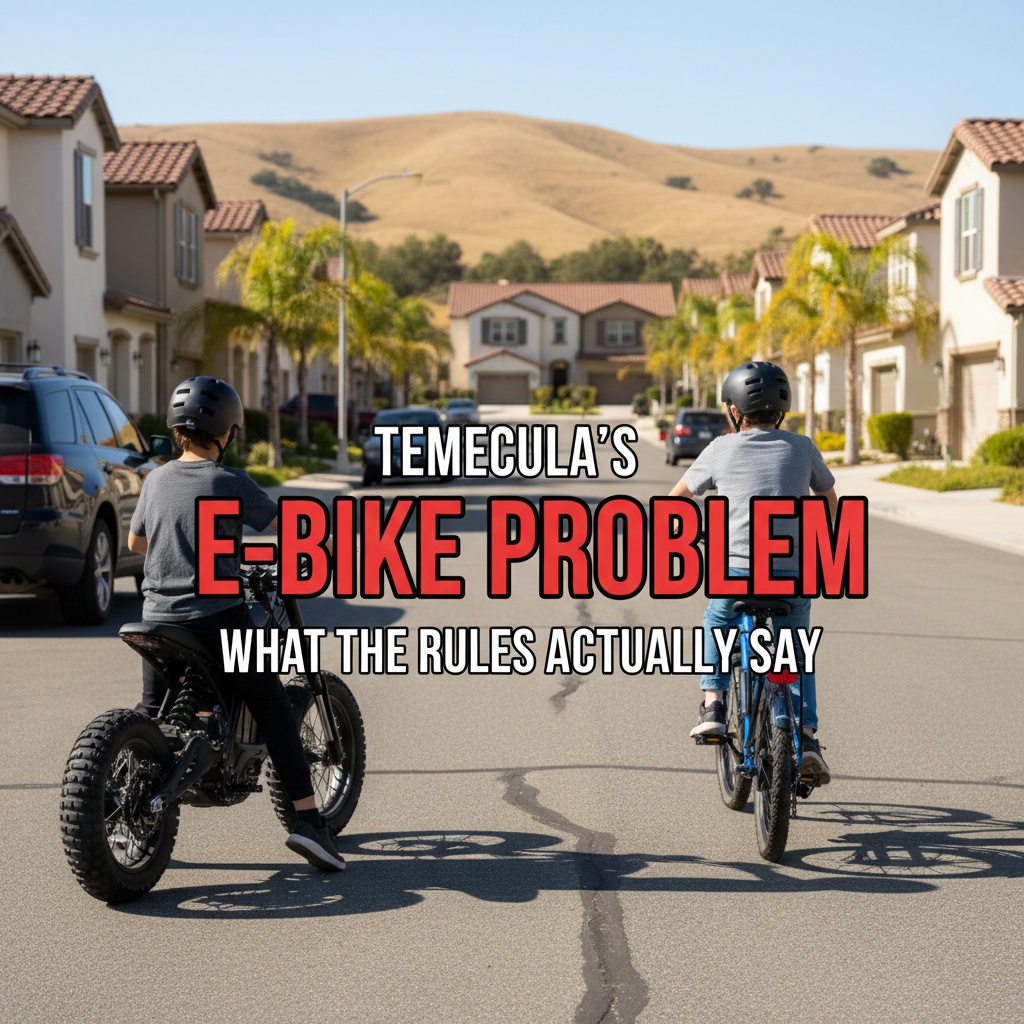
After Top of Temecula's e-bike rules explainer reached over 300,000 Temecula Valley viewers across Facebook and Instagram, five patterns surfaced in the comments over and over — and they are not the ones the city's FAQ answers.
The speed gap. The 20-mph class limit is a motor cutoff, not a speed cap. Local drivers routinely report seeing kids on Class 2 e-bikes hitting 40 mph or more on Temecula downhills — gravity doesn't care what the motor is rated for. A parent buying a Class 2 "because it's under 20" hasn't bought a 20-mph bike. They've bought a bike whose motor caps at 20; the ceiling is a hill, not a throttle.
The right-turn visibility gap. One Temecula driver described a close call on a neighborhood turn: the bike "wasn't there when I looked right, but it was there when I went to turn." That gap — the seconds between when a driver checks and when a Class 3 arrives — is the collision scenario Temecula locals describe most. Drivers calibrate their expectations for bicycles. A 28-mph e-bike approaches at almost exactly the speed of a neighborhood car, but without the visual cue of a car.
The enforcement gap. The sheriff's department can impound under AB 875. Actually catching a rider who doesn't want to stop is a different problem. The comments on the original post included riders who said outright they'd take back streets rather than pull over. The deterrent value of impoundment is real. The prevention value, less so.
The peer cost. The sharpest responses didn't come from parents. They came from teenage riders who said the kids doing wheelies down public roads had "ruined it for the rest of us." The social consequence of the bad actors is the responsible riders being lumped in with them. That dynamic is visible in the comments and visible on the streets — and it's the thing no ordinance can fix.
The infrastructure gap. Where, exactly, can a kid legally ride an e-bike fast? Class 1 on a city park trail is the honest answer, and the list of Temecula Valley park trails that accommodate it is short. This is not a reason to break the law, but it is a reason the city's dedicated bike infrastructure deserves as much attention as the citation framework.
None of these are arguments against the rules. They are the reality on top of the rules — and they are what most parents end up adjusting to once the first few weeks of ownership wear off.
The Temecula Parent & Rider Checklist
Before you buy, match the rider to the bike — not the other way around:
How to Choose the Right E-Bike for Your Family
- If you want rider is under 16 →
- Class 1 or Class 2 only — Class 3 is legally off-limits under California Vehicle Code §21213. A Class 2 is the most the rider is allowed, and even then the 20-mph motor cap is not a speed cap on a downhill — expect to discuss pacing with the rider.
- If you want rider is 16+ and commutes to a TVUSD middle or high school →
- Class 3 with TVUSD Safe Riders registration and a compliant red reflector/light — Class 3 is allowed at 16+, and the parking sticker is non-optional per the August 2025 program. The AB 544 lighting requirement is strict — one-time install on a new bike, but confirm after any crash or tune-up.
- If you want anyone in the family is tempted by a Sur-ron, Talaria, or Segway X260 →
- Don't — buy a licensed off-road motorcycle instead — These are not e-bikes under California law. They are unregistered motor vehicles, and the Riverside County Sheriff's Department is actively impounding them. If the rider wants a motorcycle, registration and licensing are the honest path, not the e-bike classification loophole that doesn't actually exist.
Before you make a purchase or before the next ride, verify each of the following:
- Class before purchase. The bike's class is usually on a sticker on the frame or in the manual. If you can't find it, the shop can identify it in 30 seconds. Don't accept "it's a regular e-bike" as an answer.
- Age fit. If the rider is under 16 and the bike is Class 3, it is the wrong bike for that rider regardless of the rider's skill.
- Helmet. Required under 18 for all classes. Required for all ages on Class 3. A $40 certified helmet is not the place to save money.
- TVUSD Safe Riders registration. If your student will park on a TVUSD middle or high school campus, the online course and sticker are mandatory. Handle it before the first day of school, not after a permit hold on the parking area.
- AB 544 lighting. Red reflector or solid/flashing red light, installed and functional, at all hours. Verify before every night ride.
- Direction of travel in bike lanes. Ride with traffic flow, same direction as cars. Against-traffic riding is the most common violation local drivers report.
- Insurance. Ask your current homeowner's and health insurer in writing whether motorized-bicycle incidents are covered. If they aren't, evaluate a specialty e-bike liability policy before the bike sees the street.
- Household rules. Write down what the rider is and isn't allowed to do — where they may ride, what time they must be home, what happens if they hit a pedestrian or get cited. Kids take written rules more seriously than verbal ones, and the exercise of writing them forces the parent to think through scenarios before they happen.
Where to Get Help Locally
Three Temecula-area shops can handle class verification, AB 544 lighting installs, and the kind of safety-focused conversation this guide recommends having before a purchase. Based on Top of Temecula's analysis of review counts and specialization across the 22 bike shops in the Temecula Valley:

E-bike specialist in Temecula. If you want to walk in, ride three different Class 1/2/3 bikes in the same afternoon, and have the class difference explained by someone who sells them every day, this is the most efficient shop. Limited to the Pedego product line — not the place for universal repairs on another brand.

Full-service Temecula shop with over 300 verified reviews. Sells and services multiple brands, and equipped to install AB 544-compliant lights and reflectors on existing bikes. The default choice if you already own the bike and need a safety-focused tune-up.

Temecula's Old Town-based shop with a strong review profile. Knowledgeable on California class rules, and a reasonable drive from anywhere in the valley. The right call when you want an unbiased class-identification conversation before buying from a chain or online.
Pricing, availability, and details for businesses mentioned in this guide were last verified against our live directory in April 2026. Contact providers directly for current rates.