A Nextdoor post from a Redhawk neighbor last week, gallbladder attacks, a referral to a clinic that won't pick up the phone, and a string of replies recommending surgeons in La Jolla and Escondido, is a small story that explains something bigger about getting medical care here. The valley's hospitals are genuinely capable. They do robotic gallbladder surgery, they hold "A" safety grades, they run the only comprehensive stroke center in southwest Riverside County. The choke point isn't the operating room. It's getting a specialist to call you back.
The Two Hospitals Most Locals Default To, and What Each One Is Actually Good At
Temecula Valley Hospital and Loma Linda University Medical Center – Murrieta are not interchangeable, and the way locals talk about them, "whichever's closer", wastes both facilities. They're built for different things.
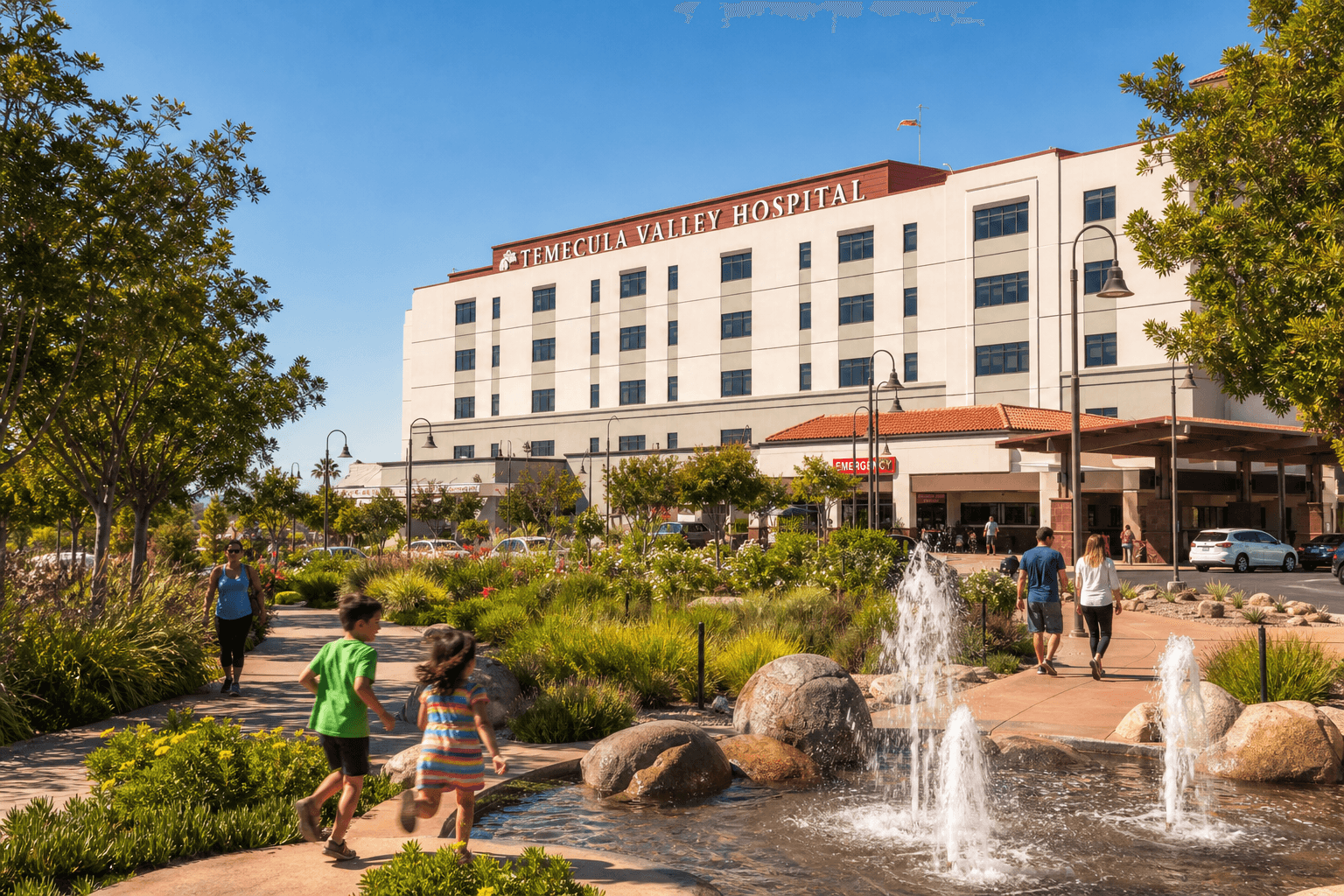
TVH opened October 14, 2013 at 31700 Temecula Parkway as a 140-bed, five-story acute care facility, and it's grown into the region's procedural hub. More than 350 affiliated physicians, over 1,100 employees, and operations run by a Universal Health Services subsidiary out of King of Prussia, Pennsylvania. The credentialing that matters: TVH is a STEMI Receiving Center and Stroke Ready Hospital designated by Riverside County EMS, and DNV has designated it as the area's only Comprehensive Stroke Center. If you're having a heart attack or a stroke in this valley, TVH is the address you want the ambulance pointed at. The hospital also pulled a Spring 2026 Leapfrog Safety Grade and the American College of Cardiology's NCDR Chest Pain–MI Registry Platinum Performance Achievement Award, and it partners with Synergy Cardiothoracic Surgery from UC San Diego Health for bypass and valve procedures, meaning the heart surgery happening on Temecula Parkway is being done by UCSD-affiliated surgeons.
Loma Linda Murrieta is a different animal. A 106-bed faith-based non-profit at 28062 Baxter Road, opened in 2011, owned and operated by Loma Linda University Health, the Seventh-day Adventist academic system out of San Bernardino. Smaller footprint, 19-bed emergency room, 256,000 square feet. What it has that TVH doesn't is a fifth consecutive 'A' Leapfrog Safety Grade and a 2026 U.S. News Best Hospitals for Maternity Care designation. Leapfrog grades measure how often hospitals hurt patients with errors, infections and accidents. Five A's in a row is not an accident.
The way to read this: if your situation is acute and time-sensitive, chest pain, stroke symptoms, a robotic surgery already on the books, TVH has the program depth. If you're choosing where to deliver a baby, or where to schedule an elective procedure and you care about infection rates, Loma Linda Murrieta wins on the metrics. The "closer to my subdivision" calculus is how people end up in the wrong building for what they actually need.
Gallbladder, Hernia, Appendix: Why You Probably Don't Need to Drive to San Diego
Back to the Nextdoor poster. She wants a "good general surgeon" for gallbladder removal, and half the replies are pointing her at La Jolla. Almost none of them mention that TVH has been doing this case with a da Vinci Xi for years.
The TVH robotic-assisted surgery program runs the da Vinci Xi for general, thoracic, breast, colorectal, hepatobiliary and urologic procedures, explicitly including inguinal hernia repair, cholecystectomy (gallbladder removal), appendix removal, and colon resection. TVH was the first hospital in Southwest Riverside County to offer cardiothoracic robotic-assisted surgery on the Xi platform, and the first in the region to offer robotic-assisted Ion bronchoscopy. This is not a small community hospital that ships hard cases out. The Xi is the same platform Scripps and UCSD use.
For outpatient cases that don't need an overnight stay, there's Temecula Valley Day Surgery, a multi-specialty ambulatory surgical center at 25495 Medical Center Drive Suite 101 in Murrieta (951-200-7777), majority owned by a Southwest Healthcare affiliate. Same parent system, lower-acuity setting, lower cost structure. A straightforward gallbladder case in an otherwise healthy patient can be done there and you go home the same day.
The hospital also operates a free physician referral line at 855-859-5203, meaning the Nextdoor poster could have called that number, not Nextdoor, and been routed to a surgeon who actually answers. The reason locals don't know this is that nobody markets a referral line the way urgent cares market themselves. But it exists, and it's the move when your assigned clinic ghosts you.
The Real Problem Isn't the Hospitals, It's Finding a Specialist Who'll See You
Here's the number that explains every "I can't get an appointment" complaint in this valley. The Inland Empire has 42 primary care physicians and 83 medical specialists per 100,000 people, compared to 60 primary care doctors and 131 specialists per 100,000 for California as a whole. We have roughly 63% of the specialist density of the rest of the state. The clinic that referred the Nextdoor poster isn't ignoring her phone because they're rude. It's because the GI scheduler is fielding a queue four months deep.
CalMatters' reporting on the same shortage found that about 42% of people in Riverside County and 62% in San Bernardino County have inadequate healthcare access, and the standard workaround is what the Nextdoor commenters were suggesting: drive to Los Angeles, Orange or San Diego counties. That's the dynamic. Local capacity exists at the hospital level, operating rooms, robotic platforms, board-certified surgeons, but the funnel feeding patients into those operating rooms is undersized. Primary care doctors who refer out, specialists who consult, schedulers who coordinate: that's the layer that's thin.
And it's getting more pressure, not less. About four in every 10 Inland Empire residents, roughly 1.88 million people, are insured through Medi-Cal, per an April 2026 California Health Care Foundation report. Medi-Cal reimburses providers at lower rates than commercial insurance, which means specialists who can pick and choose patients pick commercial ones. The Medi-Cal-insured share of the valley competes for a smaller subset of doors that will open.
So the practical advice, and I mean this as advice, not observation, is to stop treating the first referral as the only referral. If your PCP sends you to a clinic that doesn't answer, call the TVH physician referral line. Call your insurer's nurse line. Ask the PCP for a second name. Pushing harder works here in a way it doesn't in markets where the bottleneck is insurance authorization rather than physical capacity.
If You're Kaiser, Medi-Cal, or Need OB/Peds, The Rules Are Different
Insurance reshapes the map. Kaiser members operate under different rules than PPO patients, and a lot of new arrivals don't realize it until the bill arrives.
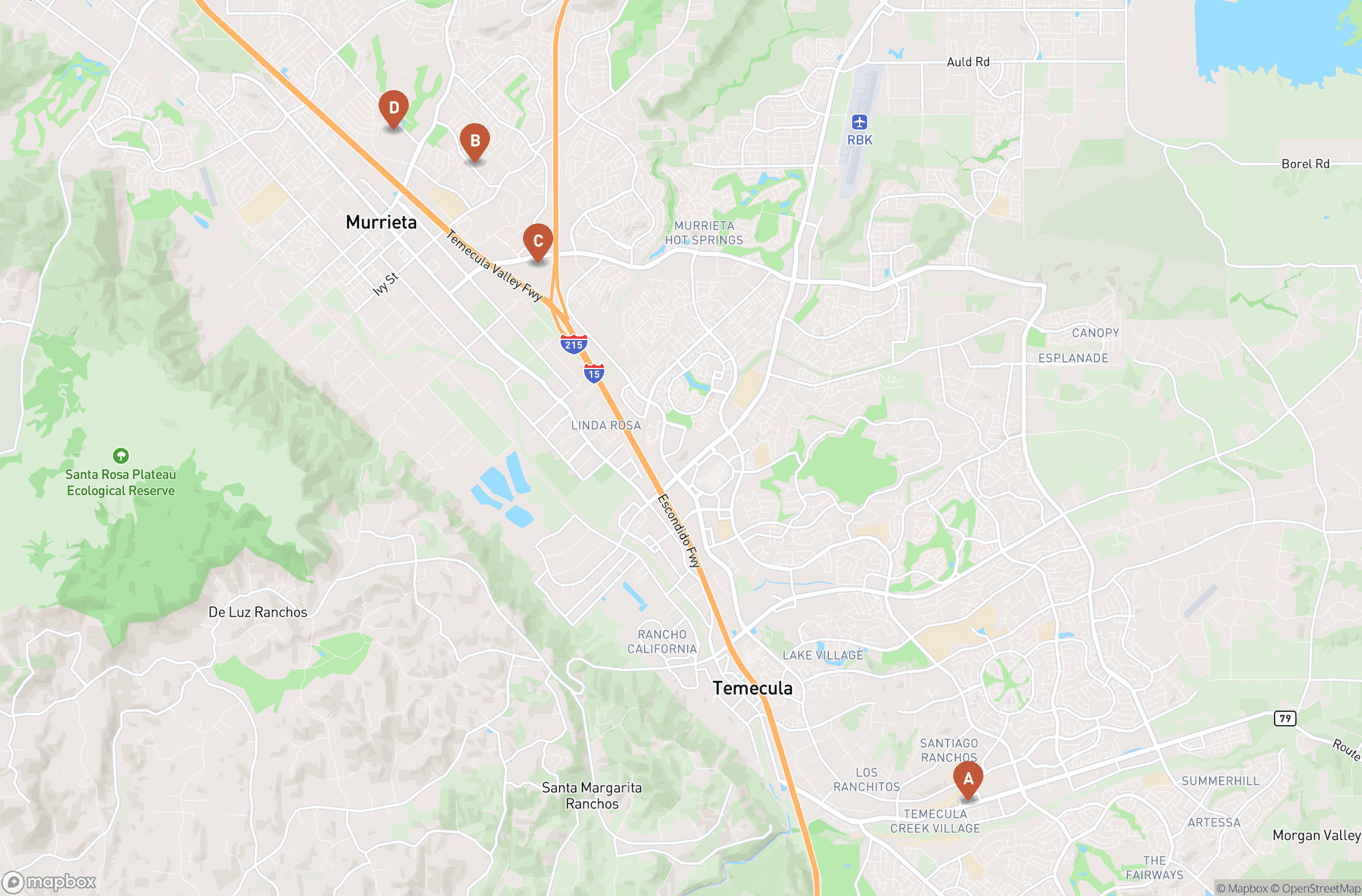
Kaiser Permanente's own facility listing for TVH describes the hospital as a contracted Plan facility, but adds the warning, in its own words, that "The Emergency Department at this facility is not appropriate for urgent care." Meaning: a Kaiser member who walks into TVH's ER for something that isn't a genuine emergency can find themselves on the hook. Kaiser's local primary care home is the Temecula Medical Offices at 27309 Madison Ave, open weekdays 8:30 a.m. to 5 p.m. Outside those hours, Kaiser's expectation is that members use Kaiser facilities in Riverside or Moreno Valley unless it's a true emergency.
For pregnancy and pediatric emergencies, the geography collapses to a single building. Rancho Springs Hospital in Murrieta, also Southwest Healthcare, a 120-bed acute care facility, operates the region's only OB Emergency Department with 24/7 on-site OB/GYN coverage and the region's only Pediatric Emergency Services, staffed by board-certified Rady Children's physicians. If your kid is having a real medical emergency, Rancho Springs is the address. If you're in labor with complications, same answer. There isn't a closer option, and that's worth knowing before you need it.
The Medi-Cal piece matters too. TVH's 2024 HCAI facility profile shows the hospital pulled $68.4 million in net revenue from Medicare Fee-for-service and $54.6 million from Medicare Managed Care, against just $15.0 million from Medi-Cal Fee-for-service and $13.5 million from Medi-Cal Managed Care. That's a payer mix tilted heavily toward Medicare and commercial. For the 1.88 million Medi-Cal-insured Inland Empire residents, the practical specialist list is narrower than the marketing materials suggest, and the appointment wait is longer. Knowing which doors your card actually opens is the difference between getting care this month and getting it in October.
What's Coming: Residency Programs, New Clinics, and the Hospital Loma Linda Is Building Onto
The shortage isn't fixed, but it's not static either. Four things are moving.
First, training. The UHS SoCal Medical Education Consortium got ACGME approval in July 2022 to launch a fully accredited five-year General Surgery Residency Program, placing three residents per year across Corona Regional, Southwest Healthcare and TVH. Residency programs are how regions grow their own surgeons, physicians tend to settle within driving distance of where they trained. Three new general surgeons per year in this system is small, but it compounds.
Second, the medical school upstream of those residencies. UC Riverside School of Medicine opened in 2013 specifically to address the Inland Empire physician shortage, and has graduated 454 physicians since. It remains the only University of California medical school without its own teaching hospital, which is a structural problem CalMatters has been hammering on, but the pipeline exists, and about 80% of incoming students have Inland Empire ties.
Third, outpatient capacity. A Riverside Medical Clinic location in Murrieta was scheduled to open in July 2025, a multi-specialty group practice now plugged into the Southwest Healthcare network, the same parent system that runs the A+ Urgent Care centers in Murrieta, Lake Elsinore and Menifee Lakes. Riverside Medical Clinic specifically targets the primary-care-and-referral layer that's been thinnest here. That's the bottleneck this market needs broken, and it's the most concrete near-term answer to the Nextdoor problem.
Fourth, beds. Loma Linda Murrieta has a 15-bed expansion project underway reconfiguring existing space for additional inpatient capacity, expanded patient services, and upgraded staff lounges. A 14% bed increase at the valley's highest-rated hospital is not a transformation, but it's the right direction at a facility already pulling five consecutive Leapfrog A's. The Loma Linda and Riverside Medical Clinic builds are the longer view on where valley health care is heading.
Reporter's Notebook: The Nextdoor poster eventually got an appointment, not through the original referral, but through a friend whose neighbor's GI doctor takes new patients on Thursdays. That's the actual access system in this valley right now: word of mouth routing around an undersized scheduling layer. If you've just moved here, the move is to ask the TVH physician referral line (855-859-5203) before you ask Facebook. The next concrete milestone to watch is the Riverside Medical Clinic Murrieta ramp through the back half of 2026, that location adding GI, endocrine and orthopedic capacity is the single biggest near-term fix to the problem the Nextdoor poster ran into.
The story to stop telling yourself is that good medical care requires a drive to San Diego. The robotic surgical platform on Temecula Parkway is the same Xi the academic centers use, the cardiothoracic team is UCSD-affiliated, and Loma Linda Murrieta's safety record beats most hospitals in Southern California. The story to start telling yourself, and acting on, is that getting through the front door takes more phone calls here than it should, and the residents who get the best care are the ones who make those calls.
Frequently Asked Questions
- Does Temecula Valley Hospital do robotic gallbladder surgery?
- Yes. Surgeons at TVH use the da Vinci Xi system for gallbladder removal, inguinal hernia, appendix and colon resection procedures, among others. TVH was the first hospital in Southwest Riverside County to offer cardiothoracic robotic-assisted surgery on the Xi platform.
- Which valley hospital has the best safety grade?
- Loma Linda University Medical Center – Murrieta just received its fifth consecutive 'A' Leapfrog Safety Grade and was named one of U.S. News' Best Hospitals for Maternity Care for 2026. Temecula Valley Hospital was also recognized in Leapfrog's Spring 2026 cycle.
- Where do I go for a pediatric or OB emergency?
- Rancho Springs Hospital in Murrieta operates the region's only 24/7 OB Emergency Department with on-site OB/GYN coverage and the only Pediatric Emergency Services staffed by board-certified Rady Children's physicians.
- Can Kaiser members use Temecula Valley Hospital?
- TVH is a contracted Kaiser facility, but Kaiser's own listing warns that the TVH Emergency Department 'is not appropriate for urgent care' for members. For non-emergency needs Kaiser members should use the Temecula Medical Offices at 27309 Madison Ave.
- How bad is the specialist shortage in the Inland Empire?
- The Inland Empire has 83 medical specialists per 100,000 people versus 131 statewide, and about 42% of Riverside County residents have inadequate healthcare access. That's why specialist clinics here are slow to return calls — it's a supply problem, not a quality problem.
Sources
- Southwest Healthcare, Temecula Valley Hospital About
- TVH Robotic-Assisted Surgery program
- TVH Cardiothoracic Surgery, Synergy / UC San Diego partnership
- TVH News, UHS SoCal MEC General Surgery Residency launch
- Loma Linda University Medical Center – Murrieta
- Loma Linda University News, 15-bed expansion project
- Southwest Healthcare, system about page
- Southwest Healthcare, Riverside Medical Clinic Murrieta
- SWH Rancho Springs Hospital, About
- Kaiser Permanente, TVH affiliated facility page
- California HCAI, TVH facility profile
- CalMatters, Inland Empire teaching hospital and physician shortage
- Highland Community News, IE Medi-Cal report (CHCF, April 2026)