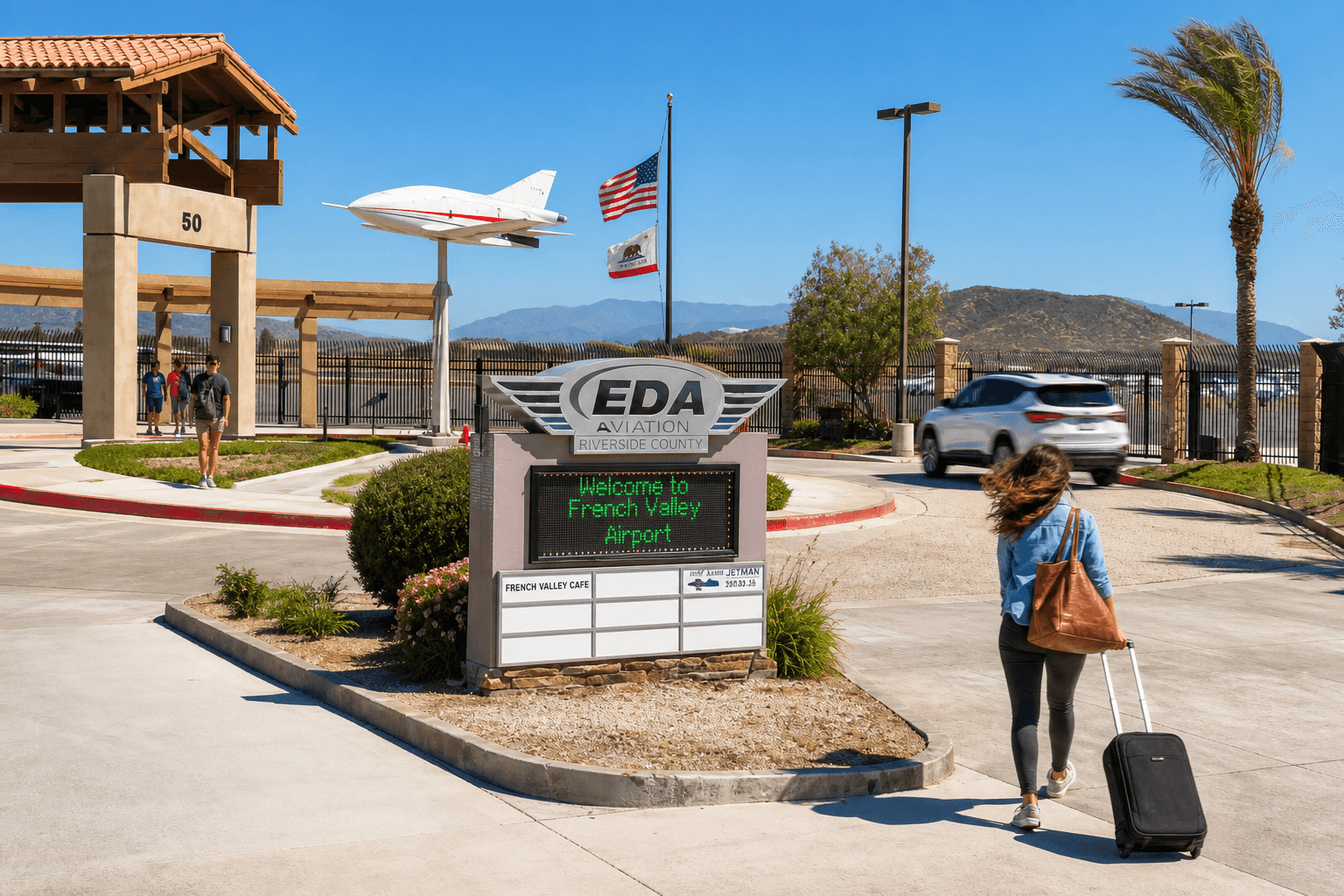
French Valley Airport just got cleared for a $2.1 million control tower, and Riverside County still won't say the word "commercial." Meanwhile, McClellan-Palomar in Carlsbad, a county-owned general aviation field with a shorter runway and a smaller catchment, is running twice-daily regional jets to Phoenix, Denver and San Francisco. The Temecula-Murrieta metro just crossed a million people. Someone in the county's Aviation Division needs to explain, on the record, why our airport is still strictly for student pilots and corporate Citations.
The Carlsbad Comparison That Should Embarrass Riverside County
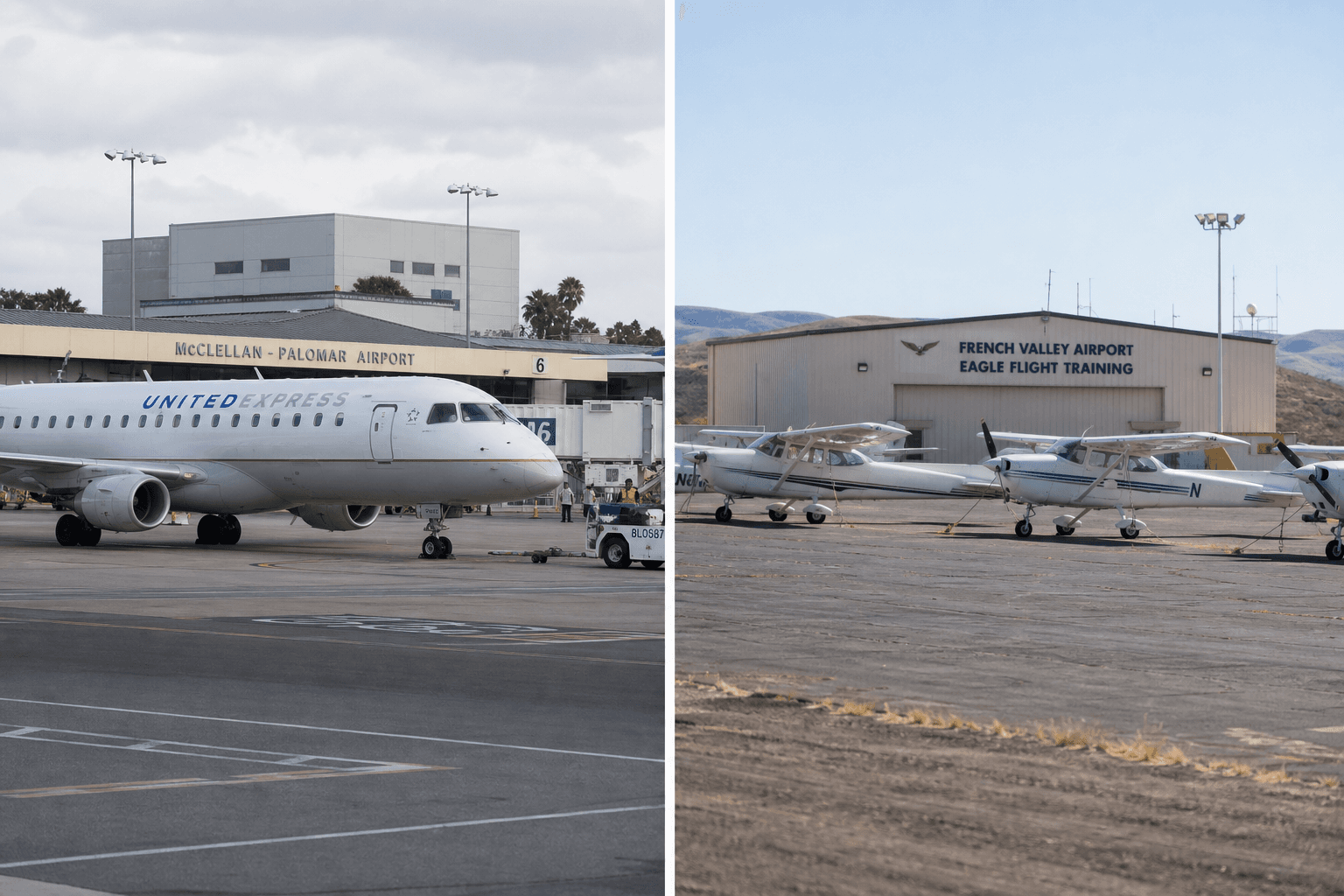
Start with the runway, because that's the excuse you'll hear first. McClellan-Palomar's single asphalt strip is 4,897 feet long. French Valley's is 6,000. Carlsbad's airport is shorter than ours, and it's now hosting 76-seat Embraer E175s on a daily schedule.
American Eagle, operated by Envoy Air, restarted commercial service at Palomar in February 2025 with two daily round trips to Phoenix and fares starting at $320. A year later, United Express via SkyWest added Denver and San Francisco on the same E175 type, under a three-year lease San Diego County supervisors approved 4–1, with a partial first-year fee waiver of $517,600 thrown in as a sweetener. Carlsbad now has scheduled service to three hub cities. We have a Cessna 172 doing pattern work.
The economic case Carlsbad uses isn't speculative either. San Diego County's own brief on the return of commercial service pegs Palomar at roughly 2,600 jobs supported, $461 million in industry activity, and $72 million in annual federal, state and local tax generation. That's before the United flights. And the airport is operating at roughly 30% of capacity, per Supervisor Jim Desmond, a former commercial airline pilot, which is the relevant credential here.
The "we're not big enough" argument also has to contend with how commercial service actually arrived at Palomar. Before American Eagle, public-charter operator JSX moved its San Diego flights to Carlsbad in 2023 and started running 30-seaters to Las Vegas and Taos under public-charter rules that skip the full Part 121 airline framework. There are at least two regulatory paths to scheduled passenger service at a general aviation field, and Riverside County has pursued neither. The runway works. The market works. What's missing is the political decision to ask for it.
What French Valley Actually Is Right Now (And What It Isn't)
The numbers describe a busy general aviation field, not a commercial one. F70 sits on 261 acres along Highway 79 between Murrieta, Temecula and Winchester, with a single 6,000-by-75-foot asphalt runway at 1,350 feet elevation. For the 12 months ending September 30, 2023, it logged 89,790 aircraft operations, an average of 246 per day, and the FAA's classification of that traffic is the part worth reading twice: 100% general aviation, less than 1% military, zero scheduled commercial. The 257 based aircraft break down as 215 single-engine, 30 multi-engine, two jets and ten helicopters. That fleet is overwhelmingly flight-school Cessnas and weekend pilots, with a thin layer of business turboprops on top.
The airport got to that size on purpose. It opened in April 1990 with ceremonies featuring then-AOPA president Phil Boyer, Congressman Al McCandless and aviatrix Bobbi Trout, a general aviation pedigree, not a commercial one. A $4 million expansion in 2003 stretched the runway from 4,600 feet to 6,000 and added 70 hangars sized for business jets and turboprops. The field hosts four flight training schools today, which is one of the highest concentrations in the Inland Empire.
The new tower project is where the language gets interesting. The FAA accepted French Valley into the Federal Contract Tower Program on July 25, 2022, and the county is now building a 448-square-foot air traffic control tower scheduled to break ground in 2026, with construction running roughly six months and a peak crew of about 35. Read the environmental notice carefully and you'll find this sentence: the project "will not increase airport capacity or alter fleet mix." That is the legally operative claim. It is also the sentence that would have to be rewritten, through a new CEQA process, before any commercial carrier could lease a gate.
That's not a procedural footnote. It's the entire ballgame. Palomar got to commercial service because San Diego County certified a Program Environmental Impact Report on December 8, 2021 that studied up to 575,000 annual enplanements. American's current lease covers up to 55,480 per year, about 10% of what the PEIR analyzed. Riverside County has done no equivalent study at French Valley. Until it does, the runway can be 10,000 feet long and it won't matter.
The Population Argument Temecula Keeps Making to Itself
Here is the number the county won't engage with: the Temecula-Murrieta metro hit 1,019,000 residents in 2025, a 2.52% jump over 2024 and the continuation of a multi-year growth streak that has occasionally pushed above 3%. Menifee was among Riverside County's fastest-growing cities in 2024 at nearly 3% year-over-year, and Temecula and Murrieta each added residents through the same period. The southwest corner of Riverside County is now a million-person market, bigger than the Carlsbad-Oceanside market Palomar serves.
The geographic argument is the one any Temecula resident already understands. The city sits roughly 58 miles north of downtown San Diego and 85 miles southeast of downtown LA, which on a good traffic day means an hour to SAN and two hours to LAX or ONT. On a bad traffic day, meaning most weekday mornings on the I-15, it can be a half-day round trip just to drop someone at the curb. Getting around the Temecula Valley still means treating the freeway as the bottleneck, while the airport solution sits eight miles north of Old Town with a 6,000-foot runway and no gate.
The regional planners already agree. The Southern California Association of Governments classifies French Valley as one of 44 general aviation regional airports that the agency considers important to absorbing Southern California aviation demand. SCAG isn't a fringe advocacy group; it's the official metropolitan planning organization for six counties. When the regional planners and the residents agree, and the county still won't move, the bottleneck is political, not technical. Temecula Valley growth is going to keep widening the gap.
What Riverside County's Aviation Director Is Actually Planning
Angela Jamison's public roadmap reads like infrastructure for a commercial pivot the county won't admit it's planning. She is the Director of Airports for Riverside County's Aviation Division and the listed public contact on French Valley's ATCT environmental notice. On March 24, 2026, the Board of Supervisors approved her division's $4,680,990 design contract with Pond and Company for towers at French Valley and Jacqueline Cochran, with $2,125,883 scoped to French Valley specifically.
The tower is the headline item, but it's not the only piece in motion. The county's adopted compatibility plan calls for a 3,600-foot parallel runway 700 feet east of the existing strip, plus an upgraded nonprecision instrument approach to Runway 18. Parallel runways are how you separate general aviation traffic from heavier scheduled aircraft. Instrument approaches are how you keep an airline schedule reliable when the marine layer rolls in off the coast, which it does, often, over this part of Riverside County.
The forward-looking number in that same compatibility plan is the one that gives away the game. The county projects French Valley activity rising from roughly 98,000 annual operations in 2009 to 185,000 within about 15 years. That's a doubling. That is not a sleepy general aviation field's growth curve, that's a Carlsbad-sized operation pretending it isn't.
What Jamison has actually said on the record is carefully bounded. She told Business View Magazine the county's five airports aim to be regional economic engines and confirmed FAA tower applications for French Valley and Jacqueline Cochran. Note what's missing: the word "commercial." Compare that with Palomar Director Jamie Abbott, who told CBS 8 in January 2025 directly that commercial flights would support the regional economy and FAA funding commitments. Carlsbad's director makes the case in plain language. Riverside County's director talks about economic engines and tower applications. The avoidance is the story.
The Winchester-Murrieta NIMBY Wave That's Coming
If a commercial proposal does land, the opposition playbook is already written, and the authors live in Carlsbad. Palomar Airport Action Network and Citizens for a Friendly Airport sued San Diego County over the 2018 master plan's noise and environmental analysis, and they're still active, Dom Betro of Palomar Airport Action Network spoke against United's expanded service at the very board meeting that approved it. CEQA challenges, conditional-use-permit fights, sustained noise complaints to the airport manager. That template will be copy-pasted onto a Winchester or Murrieta letterhead the day a commercial RFP appears.
French Valley hands opponents an opening Palomar didn't have. On July 8, 2023, a Cessna 550 Citation flying from Harry Reid International crashed 500 feet short of Runway 18, killing all six aboard, with the marine layer cited as a potential factor. That accident will be on every public-comment card from day one. It is also exactly the safety case for the new instrument approach the compatibility plan already calls for, but a public hearing room is not the place to win that argument with nuance.
The geography compounds the problem. French Valley is wedged between three growing jurisdictions, Temecula to the east, Murrieta to the west, the unincorporated Winchester community to the north, each with its own planning commission and its own subdivisions still going up under the approach paths. The Coachella Valley's Jacqueline Cochran Regional has an 8,500-foot runway and desert on three sides; that's what a true commercial-capable Inland Empire airport with room to grow looks like, and the county is building a tower there too. French Valley has subdivisions on three sides and a Citation crash on the books. Anyone who wants commercial service at F70 needs to be organizing now, registering for ALUC meetings now, and building a coalition with the Temecula Valley Chamber and the Murrieta-Wildomar Chamber now, because the moment a carrier publicly expresses interest, the noise-complaint phone tree activates and the political math gets very hard very fast.
Reporter's Notebook: The next Riverside County Board of Supervisors agenda that mentions French Valley is the document worth tracking. The tower contract has already been approved; the parallel runway and the instrument approach upgrade are the next two line items, and either one is the moment Angela Jamison either commits to a commercial-capable French Valley on the record or commits to another fifteen years of "general aviation only." If you live under the approach path in Redhawk, Murrieta Hot Springs or the new Winchester tracts, your sign-up window for the ALUC's next French Valley compatibility review is the deciding vote on which way that goes. Tower construction breaks ground in 2026.
Frequently Asked Questions
- Does French Valley Airport have commercial flights?
- No. French Valley (F70) is a general aviation airport with no scheduled airline service. For the 12 months ending September 2023 it logged 89,790 operations — 100% general aviation, with less than 1% military. The four on-field flight schools and based-aircraft hangars are the dominant uses.
- Is French Valley's runway long enough for commercial airliners?
- Yes, for regional jets. French Valley's 6,000-foot runway is more than 1,100 feet longer than McClellan-Palomar's 4,897-foot runway in Carlsbad, which now hosts twice-daily Embraer E175 service from American Eagle and United Express. Runway length is not the obstacle.
- What is the $2.1 million project at French Valley?
- Riverside County Supervisors approved a $4,680,990 design contract with Pond and Company in March 2026 for new control towers at French Valley and Jacqueline Cochran airports, with $2,125,883 scoped to French Valley. The 448-square-foot tower's environmental notice explicitly states it will not increase airport capacity or alter fleet mix.
- Who runs French Valley Airport?
- Riverside County's Aviation Division, part of the Transportation and Land Management Agency. Angela Jamison is the Director of Airports and is leading the FAA-funded tower projects at French Valley and Jacqueline Cochran Regional.
- How big is the Temecula-Murrieta market compared to Carlsbad's?
- The Temecula-Murrieta metro reached 1,019,000 residents in 2025 — a market larger than Carlsbad's that still has no commercial air service, while Carlsbad now has flights to three hub cities.
Sources
- CBS 8, Commercial flights return to Palomar Airport
- NBC 7 San Diego, United Airlines flights approved at Palomar
- CEQAnet, Air Traffic Control Tower Construction at F70
- Valley News, Supervisors approve ATCT design contract
- Riverside County ALUC, French Valley Compatibility Plan
- Riverside County Aviation Division, French Valley ATCT Notice of Intent
- Business View Magazine, Riverside County Airports
- San Diego County, Commercial Flight Services Returning to Palomar
- City of Carlsbad, McClellan-Palomar Airport
- Macrotrends, Temecula-Murrieta Metro Population
- Patch, Temecula's Population Saw An Uptick
- Wikipedia, French Valley Airport
- Wikipedia, McClellan-Palomar Airport