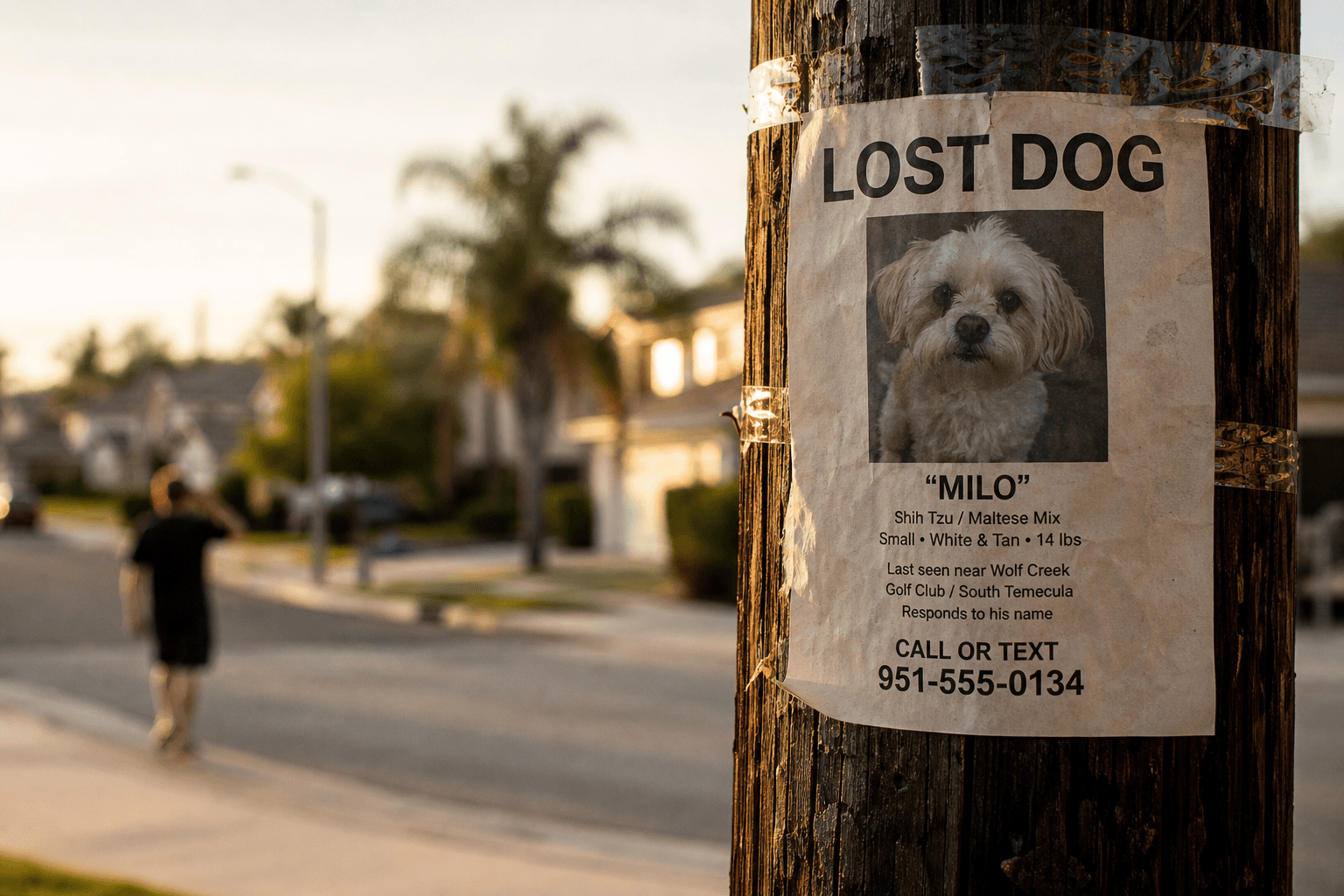
A tuxedo cat named Cee went missing near Temecula Creek over Memorial Day weekend, and her owner did the right thing, posted to PawBoost, hit the local Facebook page, filed a flyer with the shelter. That's the playbook. The problem is most Temecula pet owners don't learn the playbook until their animal is already gone, and the gap between "gate left open at 9 a.m." and "I should probably call somebody" is usually about twelve hours too long. The system here works. You have to activate it in hour one.
Start Your Search Within a Mile, Riverside County's Own Data Says So
The instinct, when a dog bolts or a cat doesn't come home for dinner, is to assume distance. They got out, they ran, they're miles away by now, somebody scooped them up and drove them to a shelter. That's almost always wrong. Riverside County Animal Services states plainly that 80% of lost pets are found within a mile of home. Not a neighborhood. A mile. For an indoor cat that squeezed through a slider, the real radius is usually three or four houses.
The recent Temecula Creek sighting pattern bears this out. Nextdoor posts from the Berringer Creek and Cedar Creek pockets show a small orange cat caught on a Ring camera within blocks of where it went missing, and a separate stray reunited after being spotted on Temecula Creek Road in February, same corridor, same tight radius. Wolf Creek, the neighborhood that backs directly onto Temecula Creek, holds roughly 6,450 residents packed into a few square blocks of single-family yards. That's a lot of fences, sheds and under-deck crawlspaces for one frightened cat to hide in for three days before it gets hungry enough to move.
The order matters. Walk the block, every block, on foot, slowly, calling quietly at dusk and dawn when cats are most likely to answer, before you drive twenty minutes to Wildomar to check the shelter intake. The shelter isn't going anywhere. Your neighbor's side yard, where your cat is currently sitting under a hot water heater, is the part of the search that closes if you don't do it in the first few hours. While you're walking, check the AFV Lost Reports page on your phone, it's already showing active flyers from Harveston Lake and the Town Center on Ynez Road, including a $500 reward for a tuxedo named Mochii. Your neighbor may already be looking for someone else's cat. Pool the effort.
Animal Friends of the Valleys Is the Shelter Your Pet Will End Up At, Here's How to Work It
If your pet does end up at a shelter, it's going to one specific shelter, and every Temecula resident should know the address by heart: 33751 Mission Trail, Wildomar. Animal Friends of the Valleys, AFV, has held Temecula's animal-control contract since 1995 and runs the regional facility that serves about 350,000 people across Temecula, Murrieta, Wildomar, Menifee, Lake Elsinore and Canyon Lake. It's the only game in town. Riverside County's own shelter system covers the unincorporated pockets; inside Temecula city limits, AFV is who responds and AFV is who holds your dog.
The two phone numbers to put in your contacts, today, before anything goes wrong: the main shelter line at 951-674-0618 and the 24/7 emergency animal services line at 1-800-375-8218. The emergency line is the one to call at 11 p.m. on a Saturday when a dog you've never seen before is standing in your front yard, or when you've just realized your cat hasn't come home and the shelter office is closed. AFV's officers respond to Temecula calls, that's the contract, and the 24-hour line is how you reach them outside business hours.
The shelter itself is the $11.4 million, 32,000-square-foot facility funded by the Southwest Community Financing Authority, a joint-powers agreement among Riverside County and the six member cities. It's not a back-room operation. AFV takes in more than 11,000 animals in a single year and partners with rescue groups across the state to place adoptables. That scale is why your missing dog can disappear into the intake stream if you don't file a Lost Report and call the front desk to describe the animal in person.
File the report on the AFV Lost Reports page the same day. Then go to the shelter in person within 72 hours, and go back every few days. Photos in a database aren't a substitute for walking the kennels, a scared cat hiding in the back of a cage doesn't always match her glamour shot. Executive director Willa Bagwell has run AFV since 2005 and helped found the organization in the late '80s, which means the institutional memory at that shelter is real. They want your animal off their hands as much as you want her back. Help them help you by showing up.
The Microchip Lie: Yours Probably Isn't Registered to Your Current Address
Here is the hardest sentence in this column to write, because the pet-owner version of me wants it to not be true: your microchip is probably not doing what you think it's doing.
The numbers on microchips are spectacular when the chips work. The JAVMA study cited across the veterinary field found microchipped dogs go home 52.2% of the time versus 21.9% for non-chipped dogs. For cats the gap is brutal: 38.5% return rate chipped, 1.8% unchipped. Twenty times better. There is no other single intervention that moves cat-recovery numbers like a chip.
And yet. The same body of research found that only 58% of microchipped animals had their chips registered with current owner contact information in any database. That means roughly four in ten chipped pets that get scanned at a shelter come back with a disconnected phone number, an old apartment address in Murrieta, or a previous owner's email from the rescue you adopted from in 2019. The chip is in the pet. The pet is in the shelter. The shelter scans the chip and calls the number. The number rings somebody who hasn't owned the cat in three years. The cat doesn't go home.
Fixing the chip is cheap. AFV runs a walk-in vaccination, microchip and spay/neuter clinic Monday through Friday from 10 a.m. to 1 p.m., no appointment, with chips at $20. The spay/neuter line is 951-674-SPAY. But fixing the registration is on you, and the shelter cannot do it for you. Log into your chip provider, HomeAgain, 24PetWatch, AKC Reunite, whichever it is, confirm the address, the phone, the email, the secondary contact. If you don't know the provider, your vet has the chip number in your file. Do this today. Not after your dog gets out. Today, before you finish this column.
Riverside County also recommends registering with Petco Love Lost, the national lost-and-found database that scans photos as a backup when chip data fails. It's free. It takes ten minutes. It's the belt to the chip's suspenders.
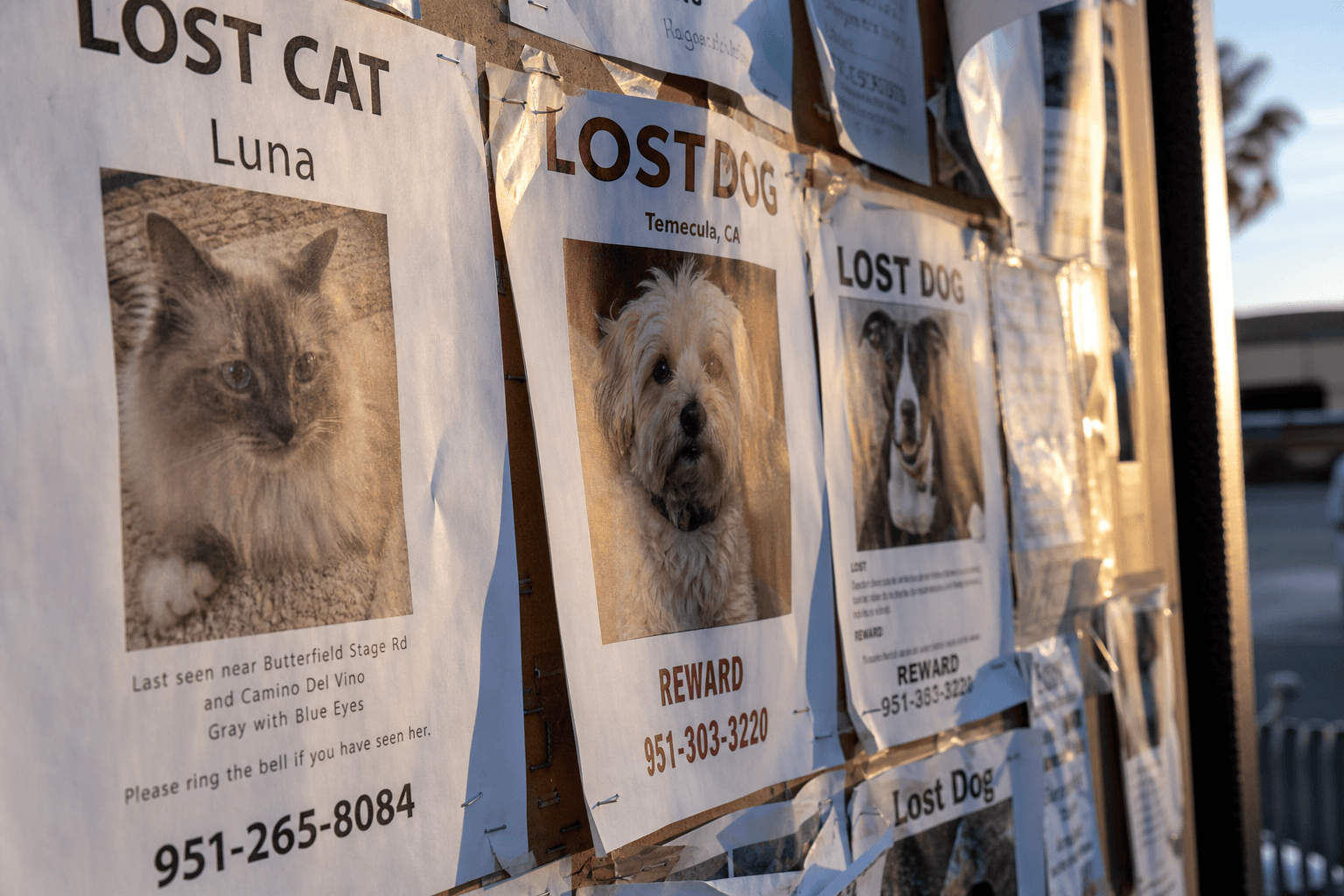
PawBoost and the 5,000-Member Facebook Group Are Doing Real Work
The reflex to roll eyes at "post it to Facebook" as lost-pet advice is understandable, most Facebook advice is bad. This particular Facebook advice is not.
The Temecula, CA – Lost Dogs, Cats & Pets page has roughly 5,005 followers, which in a city of about 110,000 means a meaningful slice of dog-walking, kid-driving, Ring-camera-watching Temecula is plugged into the alert stream. That page is powered by PawBoost, the national lost-pet platform that operates similar Facebook clearinghouses in markets across the country. Posting is free. The platform claims more than 2.2 million reunions to date and a national "Rescue Squad" of 7.5 million subscribers who get geo-targeted alerts.
The internal numbers are the part worth knowing. PawBoost's own data shows 50% of people who post a lost pet later update the listing to "reunited," and 28% of those reunions are directly attributed to PawBoost itself. A separate April 2026 dataset on community-found pets shows 25% of strays posted by community members get back to their families, three times the national return-to-home rate for shelter intakes in 2024. Translation: a stranger who finds your dog and posts a photo to that Facebook group is statistically more likely to reunite that dog with you than the shelter system itself.
The timing rule is the one most owners get wrong. Post in the first hour, not after you've exhausted the neighborhood walk. The two activities run in parallel, you walking the block, the post percolating through 5,000 phones across south Temecula, and the post is the part that gets the Ring-camera evidence pulled from the neighbor three streets over who would never have known to look otherwise. Include a clear photo, the cross streets (not the address), the time the pet went missing, and whether the animal is friendly to strangers. Update the post when you have new sightings. Delete it the day the cat comes home, so the algorithm learns that this group reunites pets.
The Coyote Problem Nobody Wants to Talk About in South Temecula
The hardest version of a lost-pet story in this valley is the one where the pet wasn't lost. South Temecula has a coyote problem, and the closer you live to the Temecula Creek and Wolf Creek corridors, the open-space drainages, the golf course edges, the hillside behind Pechanga Parkway, the more honestly you have to account for it in both prevention and search.
AFV humane officer Monique Middleton went on record with NBC4 Los Angeles about exactly this dynamic: "A lot of dogs, cats and bunnies are missing because the coyotes view them as sources of food." Summer heat is the trigger. Drought conditions push coyotes out of the open space and into yards looking for water and protein, and the protein in a Wolf Creek backyard is usually a free-roaming cat or a small dog left out at dusk.
The City of Temecula's official coyote page directs residents to report nuisance coyotes, animals that are actively going after pets, to AFV. The city's coyote FAQ lays out a hazing protocol that residents are expected to apply: loud noises, water spraying, bright lights, throwing objects, shouting. The point of hazing is to make Temecula yards unrewarding territory so coyotes go back to hunting rabbits in the creek bed. It only works if enough neighbors do it.
For the search timeline, the coyote factor means two things. First: if your cat or small dog has been missing more than 48 hours in the south Temecula corridor and there are zero sightings on cameras or the Facebook group, the math gets harder, and you should brace your kids. Second: don't stop searching. Sightings still happen at day five, day ten, week three. The shelter still gets intakes from animals who hid under a deck for a week before somebody fed them.
Field Note: If you live in Wolf Creek, Redhawk, or the Temecula Creek corridor and you have a cat that goes outside, the prevention conversation is the one to have this week, not after. Bring the cat in by dusk. Confirm the microchip registration is current. Save the AFV 24-hour line (1-800-375-8218) in your phone now. The next high-heat stretch in the National Weather Service forecast is when the next round of yard incidents will start.
The shelter contacts, low-cost clinic schedule, licensing requirements, and coyote reporting instructions above are the pieces to keep somewhere you can reach them quickly.
The single change that would move lost-pet numbers in this valley the most isn't a new shelter or a new app. It's residents spending ten minutes today logging into their microchip provider and confirming the registered phone number is the one they actually answer. AFV's June walk-in clinic hours run Monday through Friday, 10 a.m. to 1 p.m., $20 for a chip, and that's the appointment to make this week.
Frequently Asked Questions
- What's the first thing to do if my pet goes missing in Temecula?
- Walk a one-mile radius of your home before you do anything else. Riverside County Animal Services data shows 80% of lost pets are found within a mile of where they slipped out. Then file a Lost Report with Animal Friends of the Valleys and post to the Temecula PawBoost Facebook page within the first hour.
- Which shelter will my Temecula pet end up at?
- Animal Friends of the Valleys (AFV) at 33751 Mission Trail in Wildomar. AFV holds the animal-control contract for Temecula. The main shelter line is 951-674-0618 and the 24/7 emergency line is 1-800-375-8218.
- My pet is microchipped — isn't that enough?
- Only if the chip's registration is current. National data shows just 58% of microchipped pets have up-to-date owner contact info in the registry database. Log into your chip provider today and confirm your address and phone number are correct.
- How long should I hold a stray I find?
- Riverside County Animal Services asks finders to hold a stray for at least 72 hours and post it to Petco Love Lost so the owner has time to find it. Many owners don't start searching the databases until day two or three.
- Could a coyote have taken my pet in south Temecula?
- In the Temecula Creek and Wolf Creek corridors during summer months, yes — it's a real possibility. AFV's humane officer has gone on record that summer heat drives coyotes into yards looking for cats, small dogs and rabbits. Report nuisance coyotes to AFV and follow the city's hazing guidance.
Sources
- Animal Friends of the Valleys – History
- AFV Lost Reports
- City of Temecula Staff Directory – AFV contacts
- City of Lake Elsinore – Animal Control & Shelter Services
- City of Temecula – Coyotes
- City of Temecula – Coyotes FAQ
- Riverside County Department of Animal Services – Lost & Found
- PawBoost
- PawBoost – Lost Pet App Data
- PawBoost for Shelters – community reunion data
- Lost Pets Temecula CA – Facebook
- NBC Los Angeles – Temecula Coyote Warning
- JAVMA microchip return-rate statistics
- TBC Animal Rescue – Microchip registration data