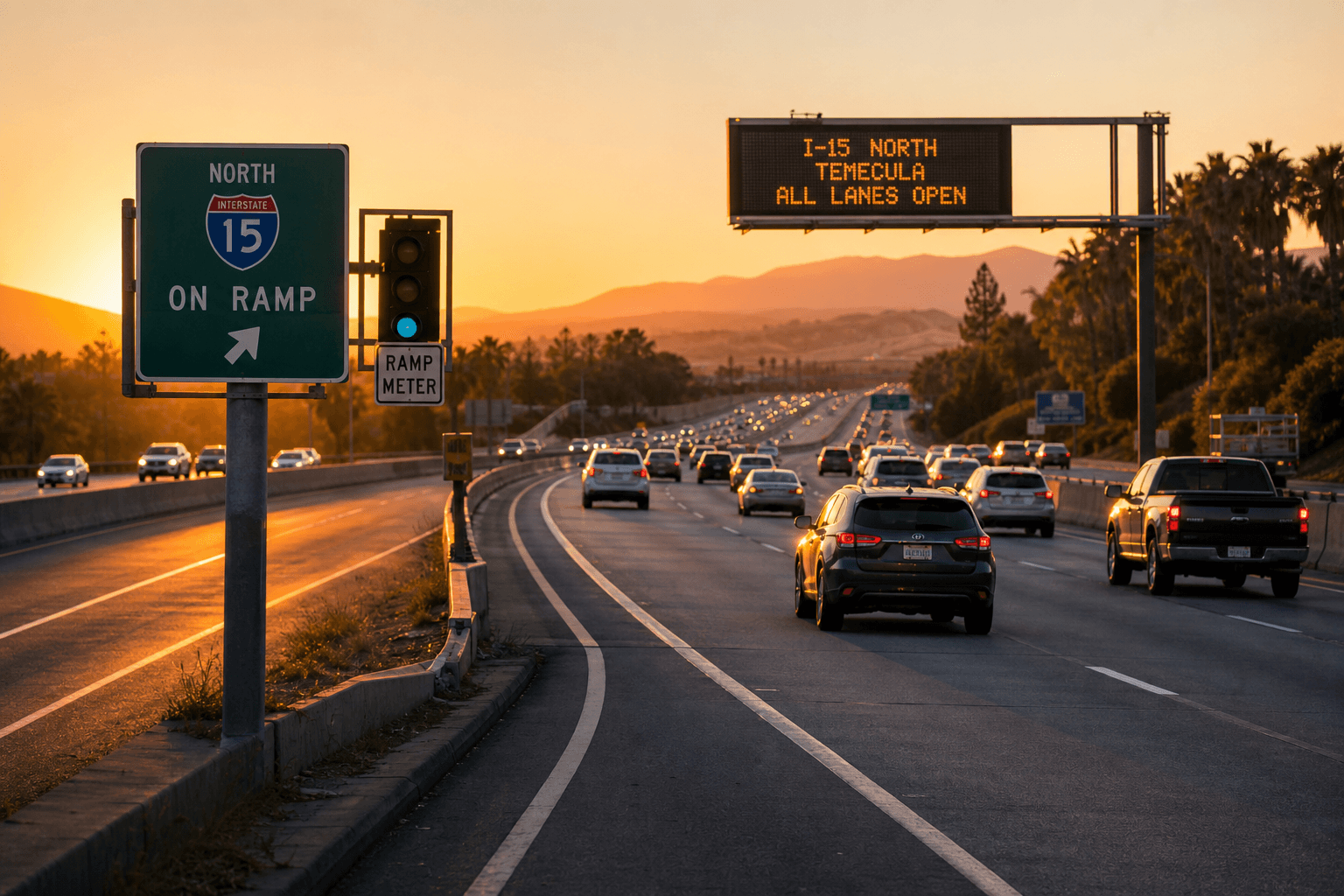
The I-15 Smart Freeway in Temecula has been live for eleven days, and the most noticeable change is the one RCTC told everyone to expect: longer holds at the northbound ramp meters during the afternoon peak. The system activated June 1 along the stretch of northbound I-15 between the San Diego county line and the I-215 split, the single worst leg of this valley's commute. RCTC is asking for two years to prove that $33 million in sensors and algorithms can do what new pavement does, at a fraction of the cost.
Where Temecula's I-15 Smart Freeway Runs, and What Switched On June 1
The activation came eleven days ago. On Monday, June 1, RCTC, in partnership with Caltrans, the City of Temecula, and the Western Riverside Council of Governments, switched on California's first-of-its-kind Smart Freeway system on I-15. Local, state, and federal officials had already gathered in Temecula on Friday, May 29 to celebrate the milestone, which means the ribbon got cut before most commuters had driven the finished product even once.
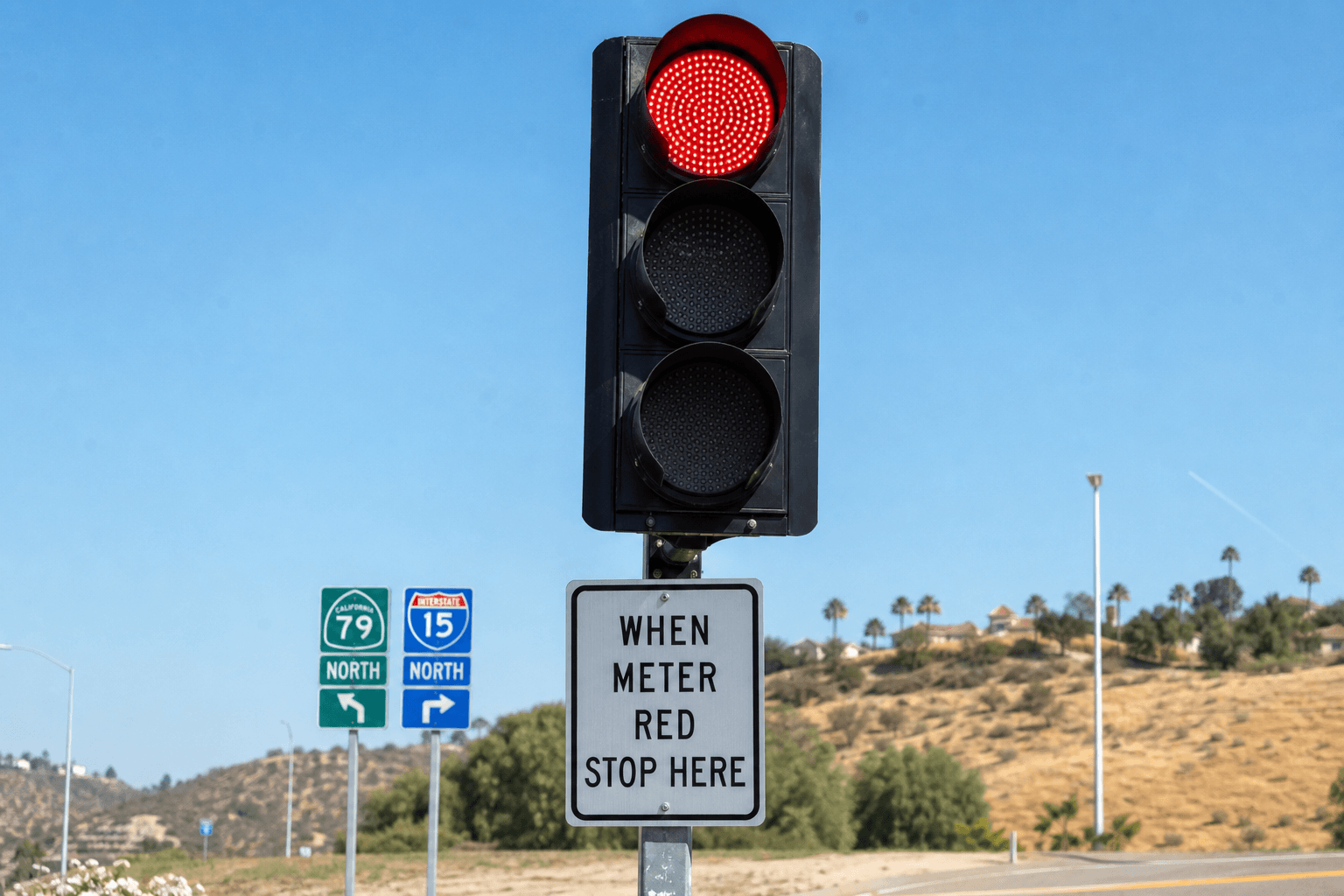
The geography is precise, and the precision is the point. The pilot covers an eight-mile, non-tolled segment of northbound I-15 from the San Diego/Riverside county line in Temecula to the I-15/I-215 interchange in Murrieta. RCTC's own diagnosis of the corridor is blunt: severe congestion driven by high volumes of vehicles entering at the Temecula Parkway, Rancho California Road, and Winchester Road on-ramps during peak afternoon and evening hours. Those three interchanges are where the system does its work. The meters there now operate in coordination to manage the rate of vehicles entering the freeway during peak periods, while digital message signs along the corridor display recommended speeds in real time.
It is worth being clear about what did not switch on. This is not a toll lane, not a new general-purpose lane, and not a southbound fix; the morning grind into San Diego County is untouched. The pilot is aimed squarely at the afternoon return trip, the leg that has anchored every commute complaint in this valley for as long as I have covered it, and the one we spend the most ink on in our Getting Around Temecula guide. Pointing an experimental system at the corridor's documented worst stretch, rather than scattering it across the region, is the right design decision, and it also means the results will be hard to spin either way.
Tire-Level Sensors, Coordinated Meters, and a No-Camera Promise
The hardware went in over the past year and a half. Construction broke ground on January 6, 2025, and the work included building ramp entrance lanes, installing tire-level sensor technology, and enhancing ramp meters so they communicate with each other. That communication is the substantive feature. The I-15 ramp meters in Temecula are not each running their own clock; per RCTC, they coordinate as a set, with the corridor's conditions feeding the timing.
The system also has an answer to the most reasonable local objection, which is that metering a ramp hard enough will push the queue backward onto city streets. RCTC says a system of algorithms and specialized monitoring teams watches the on-ramp queues, and if a backup threatens to spill onto local Temecula streets, the system increases the meter cycle speed to release more cars onto the freeway. Whether that response is fast enough in practice is exactly the kind of thing the pilot exists to find out, but the failure mode was anticipated rather than discovered.
Before anything activated, the project ran a 90-day baseline data collection period in which the sensors gathered traffic volumes, vehicle speeds, and travel times while drivers noticed no changes. That matters more than it sounds: the "before" snapshot was captured by the same instruments that will measure the "after," which makes the eventual comparison honest rather than anecdotal.
The driver-facing behavior is simple. When congestion builds, changeable message signs on northbound I-15 display "Slow Traffic Ahead" alongside a real-time recommended speed, and when traffic is free-flowing again, the ramp signals shut off entirely. And on the surveillance question that surfaces every time infrastructure gets the word "smart" attached to it, RCTC's commitment is specific and checkable: the system collects traffic-flow data only, with no photographs, no tickets, and no personal information. That is a flat, falsifiable promise, which is the kind I prefer.
The $33 Million Bet Behind the Longer Ramp Waits
RCTC has not buried the trade-off. The agency acknowledges drivers may have a slightly longer wait before entering the freeway during the two-year pilot, with the stated goal of improving overall freeway travel times. The ramp is where the cost gets paid; the mainline is where the benefit is supposed to show up. An agency that states the cost up front has earned the data-gathering window it is asking for.
The money behind the bet breaks down cleanly: of the $33 million secured for the project, $27 million came from federal funding, the State of California provided $1 million, and $5 million arrived through a congressional Community Project Funding request by Representative Ken Calvert. RCTC Chair Raymond Gregory supplied the thesis statement at launch: "Building our way out of traffic congestion is not an option." Agree or not, that is the wager in one sentence, and it is the cheaper wager by an order of magnitude compared to corridor widening.
The argument I find most persuasive is not about travel times at all. A Caltrans letter cited by the City of Temecula documented an average of 1.73 accidents per day on the 7-mile stretch between the county line and the I-15/215 junction over 2015-2017, with fatal and injury accident rates above the statewide average. Temecula traffic on I-15 is not just slow; it is measurably more dangerous than the state's baseline. If smoothing the merge zones moves that number, the meters justify themselves regardless of what they do to anyone's arrival time.
The street-spillover concern got physical mitigation too, not just algorithmic. RCTC Deputy Executive Director David Knudsen, in a Press-Enterprise interview republished by Government Technology, said crews added and extended lanes at the Winchester Road, Rancho California Road, and Temecula Parkway on-ramps specifically to prevent traffic backups on local streets.
How the Smart Freeway Pilot Gets Judged: a Dashboard and a May 2028 Deadline
Eleven days of metering is not a verdict, and neither is six months of it. Knudsen put the smart freeway pilot's window at two years, running through May 2028. The corridor will get judged on the full span, and the honest position right now is that nobody, including RCTC, knows the answer yet. The difference is that RCTC has committed to showing its work.
That commitment has a wrinkle worth tracking. The June 1 activation press release promised a public performance dashboard by the end of the year. A separate RCTC project update was more specific and more ambitious, pointing to a launch at smartfreeway.org that would share traffic volume and travel-time data with the community. Two RCTC communications, two timelines. The dashboard is the entire accountability mechanism here, the thing that lets residents evaluate the pilot on numbers instead of freeway-forum sentiment, so the gap between "spring" and "end of the year" is not a nitpick. This site will check smartfreeway.org and report when the data actually appears.
The system's lifespan also extends past the pilot on paper. The City of Temecula says the Smart Freeway is compatible with existing Caltrans ramp metering, allowing it to remain in place beyond the two-year window, and the city expects improved reliability to enhance on-time service of Riverside Transit Agency's CommuterLink Express Route 206. A freeway experiment that doubles as a transit reliability play is a better-structured experiment.
French Valley, a Rapid Bus, and the Rest of the Corridor Work
The metering project lands in a corridor that has been under continuous repair. The I-15/French Valley Parkway Phase 2 project, largely completed in April 2025, built two northbound collector/distributor lanes approximately 3 miles long plus a flyover bridge to eliminate a choke point that previously caused weekday backups stretching 3 to 12 miles into San Diego County. That project was concrete and steel; the Smart Freeway is software and sensors. The corridor needed both, and judging the new system requires remembering the older fix is already in the ground underneath the comparison.
Getting the new system built carried its own short-term pain: construction required a full closure of the northbound I-15 Temecula Parkway on-ramp from May 11 to May 19, 2025, to demolish and reconstruct portions of the ramp and add a lane.
The demand side is getting attention too. SANDAG has been exploring a Rapid 483 bus route from Temecula to San Marcos aimed at easing I-15 congestion for Southwest Riverside County commuters who cross into San Diego County for work and school. For a valley where the commute is the recurring asterisk in every conversation about quality of life, a theme that runs through our entire Living in Temecula guide, taking cars off the freeway and managing the ones that remain are complementary strategies, not competing ones.
The political attention on the corridor is also durable. Matt Rahn, unanimously selected by the City Council on December 9, 2025 to serve as 2026 Mayor Pro Tem, led an investment of over $100 million in the I-15 corridor during his first eight years on the council, according to his official city biography. The Smart Freeway is the newest line item in a corridor portfolio that now exceeds nine figures.
The Drive: The commuter this system was built for enters at Rancho California Road or Temecula Parkway somewhere in the late-afternoon peak, heading home from a job across the county line. For that driver, the trade is concrete: a longer hold at the meter in exchange for a mainline that, in theory, stops dissolving at the merge points. The number that settles whether the trade paid off is the travel-time line on RCTC's promised dashboard, due by the end of 2026, and the full verdict on the pilot comes due May 2028.
Frequently Asked Questions
- What is the I-15 Smart Freeway in Temecula?
- It is an eight-mile, non-tolled segment of northbound I-15 from the San Diego/Riverside county line to the I-15/I-215 interchange, equipped with coordinated ramp meters and real-time speed-advisory signs. It activated June 1, 2026.
- Does the Smart Freeway take photos or issue tickets?
- No. RCTC states the system collects traffic-flow data only and does not capture photographs, issue tickets, or collect personal information.
- How long does the Smart Freeway pilot last?
- The pilot is a two-year program expected to run through May 2028, though the City of Temecula says the system is compatible with existing Caltrans ramp metering and can remain in place afterward.
- Why are the I-15 on-ramp waits longer now?
- Ramp meters at Temecula Parkway, Rancho California Road, and Winchester Road now coordinate to manage how quickly vehicles enter the freeway. RCTC acknowledges drivers may wait slightly longer at ramps, with the goal of faster overall freeway travel times.
- Where can residents see whether the system is working?
- RCTC has promised a public performance dashboard by the end of the year, and a separate RCTC project update pointed to a launch at smartfreeway.org with traffic volume and travel-time data.