Temecula construction projects hit three very different milestones this month, and they deserve to be read as one story. Eleven days ago, on June 1, RCTC activated California's first Smart Freeway on northbound I-15, the start of a two-year pilot. Meanwhile, out on SR-79 near Aguanga, Caltrans flagging crews are still holding weekday traffic for waits approaching half an hour at a time, and the city's next big interchange phase has a finish line all the way out in 2029.
What drivers need to know:
- I-15 Smart Freeway: live since June 1; adaptive ramp meters now run at Temecula Parkway, Rancho California Road, and Winchester Road.
- SR-79 near Aguanga: weekday flagging 6:30 a.m. to 6:30 p.m., waits of approx. 25 minutes per flagging location, through spring 2027.
- French Valley Parkway Phase 2: done; completion celebrated June 16, 2025.
- French Valley Parkway Phase 3: design and right-of-way work underway, expected completion March 2029.
- Full project list: Temecula's FY 2026-30 Capital Improvement Program, presented to the City Council May 22, 2025.
Temecula Construction Projects, Worst First: SR-79 Shoulder Widening Near Aguanga
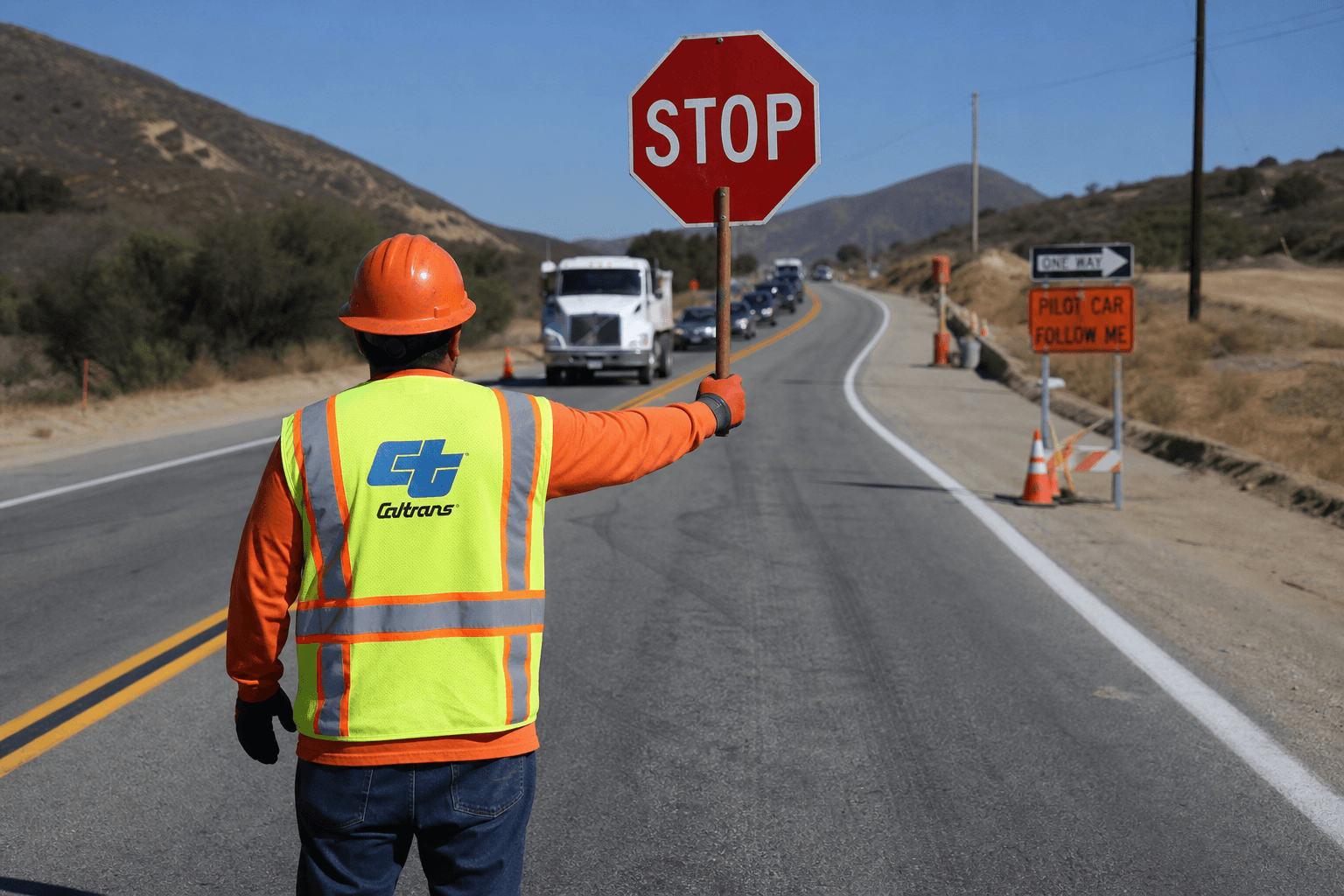
Start with the one generating the most grumbling, because the numbers earn it. Caltrans contractor crews are continuing a $61 million project on State Route 79 near Aguanga, running from north of the SR-371 Junction to south of Pauba Road. Caltrans says weekday daytime flagging operations run 6:30 a.m. to 6:30 p.m., with expected waits of approximately 25 minutes per flagging location, and expected completion is spring 2027.
Read that flagging window again. It covers the entire working day, Monday through Friday. If you live in Anza or Aguanga and commute toward Temecula, there is no clever departure time that gets you around this; the only flag-free weekday hours are before dawn and after dinner. And note the phrasing: the wait is per flagging location, not per trip. The SR-79 shoulder widening project is, for the people who drive that corridor daily, less a construction story than a recurring tax on their time, payable through spring 2027.
The timeline is the part that should bother you even if you never drive SR-79. According to the state highway log at cahighways.org, this shoulder and rumble strip project was added to the state SHOPP program in June 2017 and was originally programmed with construction starting in August 2022, with a total project cost of $63,028,000 including capital and support costs. If the spring 2027 date holds, that is nearly a decade between the state deciding to do the work and drivers seeing the last cone picked up. For a shoulder widening. This is the baseline pace of state highway work in our corner of Riverside County, and it is the right context for judging every other project on this list.
French Valley Parkway Phase 2: The Win Column
The tracker needs a win column, and the French Valley Parkway Improvements Project earned its spot. The City of Temecula says Phase 2 construction was largely completed in April 2025, and the city, RCTC, and project partners celebrated completion on June 16, 2025. The one-year mark of that ribbon-cutting lands June 16, four days from now, and it is worth marking, because RCTC allocated $47 million in State Transportation Improvement Program funding to this project, one of its largest such allocations ever.
The stakes were not abstract. The city says the bottleneck Phase 2 addressed previously caused weekday back-ups stretching 3 to 12 miles into San Diego County. Twelve miles. Anyone who drove the I-15 through the north end of the valley before this work knows those numbers are not padding; the crawl past the French Valley area was the single most reliable misery in the regional commute.
My read: Phase 2 matters less as a finished interchange than as proof of concept. The same agencies now asking residents for patience on SR-79 and attention on the Smart Freeway actually delivered a nine-figure-adjacent infrastructure project, and delivered it before the celebration date rather than years after. When you are deciding how much credibility to extend to the March 2029 promises later in this tracker, the June 2025 ribbon-cutting is the strongest evidence in their favor.
The I-15 Smart Freeway: California's First, Running Through Temecula
The headline project of 2026 is unquestionably the I-15 Smart Freeway in Temecula. RCTC, in partnership with Caltrans, the City of Temecula, and the Western Riverside Council of Governments, activated the system on June 1, making it the first of its kind in California and beginning a two-year pilot period.
The target is the stretch every local already knows by feel: severe congestion on northbound I-15 from the San Diego/Riverside County line up to the I-15/I-215 interchange in Murrieta, caused by heavy volumes entering at the Temecula Parkway, Rancho California Road, and Winchester Road on-ramps. Per RCTC's project page, the system works this non-tolled segment with advanced tire-level sensors that continuously analyze real-time traffic volumes, speeds, and travel times along the eight miles; adaptive ramp meters at those three on-ramps that function as a coordinated system, adjusting in real time to allow more or fewer vehicles onto the freeway; and digital message signs displaying recommended speeds and current conditions to keep traffic flowing steadily.
The philosophy behind it was stated plainly at the launch. RCTC Chair Raymond Gregory said it directly: "Building our way out of traffic congestion is not an option." That is a transportation agency chair, on the record, saying the lane-widening era is not the plan for this corridor. Whether you find that refreshing or alarming probably depends on how much faith you put in ramp meters, but it makes the next two years genuinely consequential. This is not a project that quietly improves a road; it is a test of an entire approach to congestion, run live on the commute thousands of locals make daily. If you are one of them, our Temecula commuting guide covers the corridor in more detail.
Who's Paying: The $33 Million Behind the Pilot
Follow the money and the Smart Freeway looks like a federal bet placed squarely on Temecula. Of the $33 million secured for the project, RCTC's launch announcement breaks it down as $27 million from federal funding, $1 million from the State, and $5 million secured through a congressional Community Project Funding request by Representative Ken Calvert.
That mix tells you two things. First, Sacramento's million-dollar contribution to a first-in-the-state project is conspicuously small; Washington, not the state, is underwriting California's first Smart Freeway. Second, the structure of the spend matches the structure of the promise: this is explicitly a pilot, two years to prove the concept on those eight northbound miles. Pilots produce data, and data produces decisions. The $33 million question is whether sensors and coordinated ramp metering can deliver measurable relief on a corridor where, by the chair's own framing, more pavement is off the table. If the answer is yes, expect this model to travel well beyond the valley. If the answer is no, the region will have spent two years finding out, which, against the SR-79 timeline above, is honestly a bargain in transportation-planning terms.
French Valley Parkway Phase 3 and the FY 2026-30 CIP
The pipeline does not stop with what is already built or blinking. French Valley Parkway Phase 3 is in motion: the city says design, environmental, and right-of-way work began in April 2025, with expected completion in March 2029. That is the long-horizon date on this tracker, and right-of-way work is exactly the unglamorous phase where big projects either stay on schedule or quietly slip, so it is the line item worth checking on each year.
For residents who want the whole picture in one document rather than one blog post, the city has already published it. Temecula's Fiscal Year 2025-26 Annual Operating Budget and Fiscal Years 2026-30 Capital Improvement Program were presented to the City Council on May 22, 2025. The CIP covers major projects exceeding $30,000 in cost, spanning public buildings, infrastructure, parks, and redevelopment projects. My recommendation is unambiguous: the CIP is the single best place to separate what is funded from what is merely discussed, and anyone settling into the valley (our Living in Temecula guide is the companion read) should skim it once a year the way you would a property tax bill. Between now and then, the date to circle on this tracker is March 2029, when Phase 3 is expected to close out the French Valley Parkway story for good.
The Drive: If your morning starts at the Rancho California Road on-ramp, you are now a data point. The meter deciding when you merge is feeding the two-year case for whether ramp coordination replaces lane-building as this region's congestion strategy, and your commute times are the evidence. For the Anza and Aguanga crowd, the calculus is grimmer but simpler: the flagging crews own your weekdays until the job wraps, so the next hard date that actually changes a local's daily life is the SR-79 finish in spring 2027.
Frequently Asked Questions
- When will the SR-79 shoulder widening project near Aguanga be finished?
- Caltrans expects completion in spring 2027. Until then, weekday flagging operations run 6:30 a.m. to 6:30 p.m., with waits of approximately 25 minutes per flagging location.
- What is the I-15 Smart Freeway in Temecula?
- It is California's first Smart Freeway, activated June 1, 2026 as a two-year pilot. Sensors, adaptive ramp meters, and digital message signs manage northbound I-15 traffic along an eight-mile, non-tolled stretch.
- Is French Valley Parkway Phase 2 finished?
- Yes. The City of Temecula says Phase 2 construction was largely completed in April 2025, and the city, RCTC, and project partners celebrated completion on June 16, 2025.
- When will French Valley Parkway Phase 3 be done?
- Design, environmental, and right-of-way work began in April 2025, with expected completion in March 2029.